
Consider what happens when a buyer finds your content for the first time.
They are not in a neutral state. They are carrying a problem. It is weighing on them professionally, possibly personally. They are looking for something that makes them feel less alone in it, something that suggests there is a way through.
What most B2B content gives them instead is a product explanation, a feature list, or a thought leadership piece so carefully balanced it says nothing.
They leave. And four out of five times, they have already decided who they will buy from before they ever speak to anyone.
The research
6sense’s 2025 B2B Buyer Experience Report found that 95% of the time, the winning vendor is already on the buyer’s Day One shortlist. The psychology is shaped by content long before any sales conversation takes place.
The cost of content that does not connect doesn’t mean low engagement. It is a loss of understanding, trust and even deals to competitors whose content made the buyer feel understood first.
The real gap
Kahneman. Cialdini. Thaler. Most marketers would have come across their work.
And yet almost none of it shows up in how B2B content is actually built. Social proof gets dropped in at the end. Anchoring happens by accident. Framing is rarely considered at all.
A 2025 study found that buyers are systematically influenced by framing effects, anchoring bias, loss aversion, and social proof at every stage of the buying journey. The content most organisations are creating is not engaging with any of this.
There is a gap that goes beyond awareness. It is application.
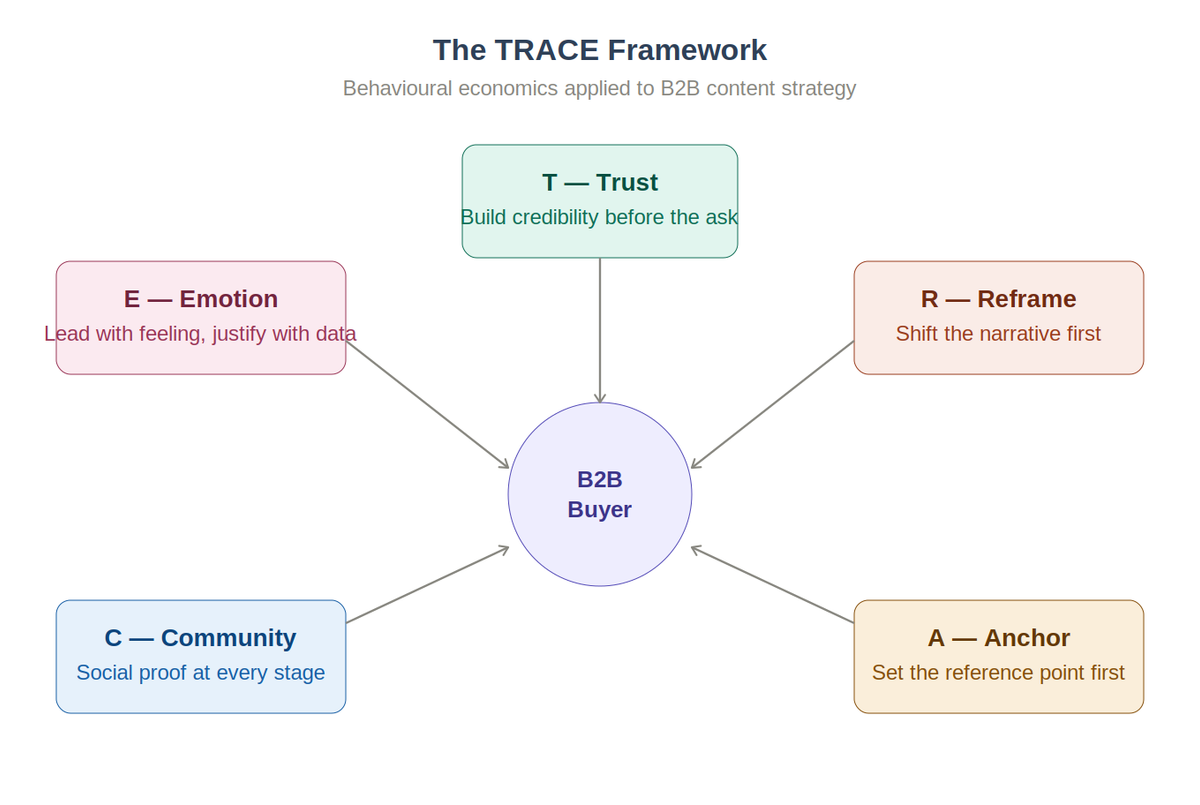
TRACE closes that gap.
The TRACE Framework
Five principles. Each one drawn from behavioural science. Each one with a direct implication for how you write and structure content.
T — Trust
Think about the last time you felt genuinely understood by a brand. They addressed a specific pain point in your life.
It probably happened when someone described your situation so accurately that you felt they’d been inside your head. Before they offered anything, before they made any kind of case, they showed you they knew what you were living with.
That is what Trust does in content. It earns the right to be heard by demonstrating understanding before asking for anything in return.
Most B2B content skips this entirely. It leads with research, product capability, with proof of results. Yes, all of that matters. But it lands differently when the reader already feels seen.
In practice:
Lead with the tension your buyer is carrying, not the solution you are selling
Spend real time in the problem before you move toward an answer
Write from inside their experience, not generically which doesn’t connect.
Why it works
Psychologists describe this as the feeling of being known, a shortcut the brain uses to fast-track credibility. When someone understands your situation, you trust their perspective. That changes how everything else in your content lands.
R — Reframe
Your buyer arrives with a view already formed. They think they know what the problem is. They think they know what kind of solution they need. They have probably already started evaluating options based on that framing.
Reframing in content means helping buyers see the problem differently, before you offer anything. Research from Emblaze found that buyers change their problem statement an average of 3.2 times during a complex purchase. The content that shapes those shifts has disproportionate influence on the outcome.
This is the difference between a brand that informs and a brand that leads.
In practice:
Build messaging around the gap between what most people believe and what’s actually true
Open talks and webinars with a tension that reorients how the audience sees the problem
Demystify assumptions to show what was assumed versus what turned out to be true
The data
Problem-focused sellers are 30% more effective than solution-focused ones. Only 13% take that approach (Emblaze, 2024). Content that reframes does the work that most sales conversations miss entirely.
A — Anchor
The first number, idea, or reference point a buyer encounters shapes everything that follows. This is anchoring, and it is one of the most powerful and most wasted opportunities in B2B content.
Most brands anchor on themselves. Price. Product features. Company history. The reader processes all of it relative to a reference point they brought with them, which you had no part in setting.
The opportunity is to set the anchor first. Before you introduce anything about what you do, establish what the problem is worth. What does it cost to leave it unsolved? What is the operational drag, the revenue impact, the reputational exposure?
When a buyer has sat with that number, everything else feels proportionate.
In practice:
Open long-form content with data that quantifies the problem, not the solution
Sequence emails so the cost of inaction comes before the call to action
In proposals, anchor on the gap before you introduce how you close it
C — Community
B2B buying is rarely a solo act. There is a committee, formal or informal, and behind every person in that committee is the same unspoken question: am I the only one thinking about this?
Social proof answers that question. It tells the buyer that others in their position have faced the same problem, made a similar decision, and come out the other side. That is not a minor reassurance. In high-stakes decisions, it is often the thing that tips the balance.
The mistake is treating social proof as a closing tool. It belongs across the entire journey, from the first article a buyer reads to the final conversation before they sign.
In practice:
Bring client voices into thought leadership, not just sales pages
Tell client stories, the person, the stakes, the uncertainty, the outcome
Use and create content around peer data and benchmarks to show buyers what others in similar positions are doing
B2B buyers average 27 touchpoints with vendors before making a decision, across more than 10 channels. Social proof needs to show up wherever buyers are forming their view, not just at the end of the funnel.
E — Emotion
Behind every business case is a person.
They are managing the expectations of people above them. They are aware of what happens if this goes wrong. They want to feel confident in the decision, not just justified by it.
This is the dimension of B2B buying that content completely ignores. This requires knowledge sharing, articulation of the emotion and not operating in silos, which can become complex.
The most effective content acknowledges what the buyer is feeling before it tells them what to think. It speaks to the person, not just the role.
In practice:
Name the personal stakes alongside the business ones: reputation, confidence, and team pressure
Write conclusions around how the reader will feel having acted, not just what they will achieve
Use specific, real stories and named situations where ambiguity is dissolved
A final thought
Every piece of content you publish is a conversation with a person who has a problem they need to solve and a decision they are nervous about making.
They do not need more information. They need to feel that someone understands their situation, that the problem is real and worth solving, that others have been where they are and found a way through, and that the decision they are considering is a sound one.
That is what TRACE is designed to deliver. Each pillar is a question you intentionally ask before you write, not a box you check as an afterthought.
The content that builds lasting commercial advantage is the content that treats buyers as the human beings they are. That has always been true. TRACE is just a way of making it deliberate.
Sources: 6sense B2B Buyer Experience Report 2025 • Emblaze B2B Buying Research 2024 • Shah & Vasudevan, Behavioral Economics and Its Impact on Consumer Decision-Making, IAJIR Vol. 12 No. 1, 2025 • Kahneman, D. Thinking, Fast and Slow (2011) • Thaler, R. & Sunstein, C. Nudge (2008)