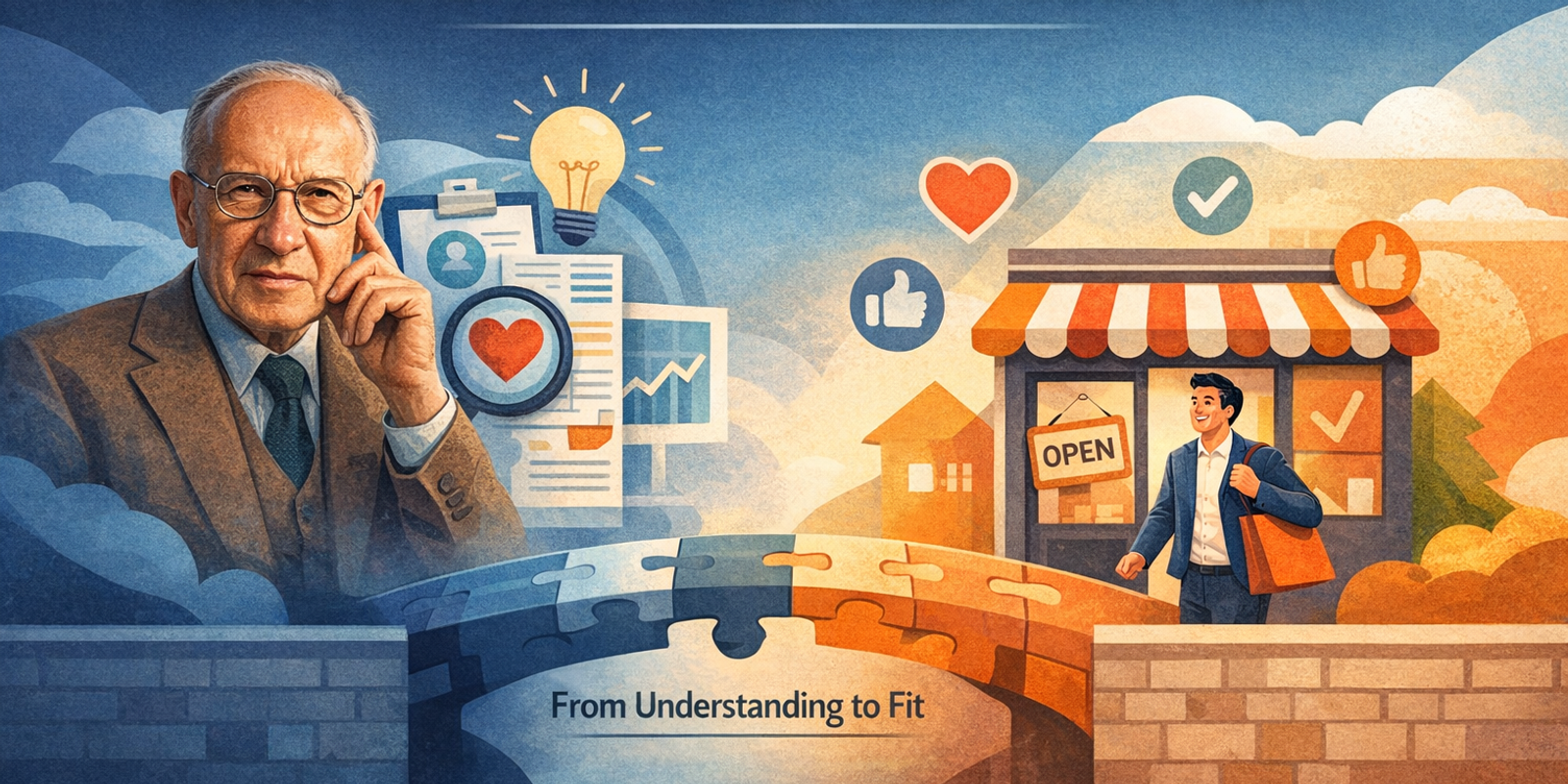
Peter Drucker has been quoted as saying that “the aim of marketing is to know and understand the customer so well the product or service fits and sells itself.”
Developed from the 1950s onward, his core idea is that marketing’s primary job is to create and serve the customer to achieve a strong fit between what the needs are and what the business offers.
That means shaping the product, service and experience around the customer so that much of what we think of as “selling” i.e. promotion becomes almost needless because the offer feels obvious.
In theory his logic is timeless and independent of channel, whether you’re running email campaigns or optimising journeys. In reality marketing is getting louder and at times, less meaningful.
Drucker’s idea that marketing should understand the customer so well that what you offer feels like a natural fit makes perfect sense in theory.
In practice it’s much harder to apply.
It requires organisations to go deep into what they offer, to bring departments together and have the right data in place to support activity. In reality his concept has been flipped, when you tell organisations to slow down, it doesn’t yield immediate results. Not compared to immediate gains from promotional activity, it feels less visible and tangible.
Does this concept sit with marketing alone, I would argue it doesn’t. Knowing the customer impacts the organisation as a whole, from culture to data. Yet, it has been left to marketing to action what is often a structural problem. If this were broken down and the intention was there, organisations would need to gather insight they may not have, explore and map journeys that require additional resources and look at behaviours of their customers, to name a few, to begin this journey. The results would not be immediate.
Only then could activity begin. This is why companies often go for the path of least resistance and immediate results.
It doesn’t mean that marketing teams don’t attempt this, but short-term wins will always take precedence because they help reach goals and manage stakeholder pressure.
Knowing the customer shapes how people experience an organisation long before a decision is made and long after it’s justified.
Examples of automation brings Drucker closer to reality
In an ideal world Drucker’s concept is strong, but it could be argued, this was pre-widespread internet, automation and technology there was less data, slower feedback, but still some infrastructure.
Tech companies understand the importance of this and through technology and automation has made parts of his ambition more achievable:
- Advanced organisations such as Zara have data embedded into company operations to inform decisions. Customer behaviour, product usage and feedback are analysed in near real time to give a living picture of needs and friction points.
- Organisations like Amazon adapt products, offers and timing based on what they see.
- Retailers with strong data structures show that personalisation is noticed by customers. Recent studies suggest 82% of customers are more likely to buy from brands that offer personalised experiences, for example Spotify.
Automation and strong data understanding rooted in the business increase the speed and granularity with which you can pursue fit, right down to the level where experiences begin to feel like they “sell themselves”.
Half a century since Drucker’s recommendations, how far have we come?
Every start-up event I went to last year, and much of the research I read, highlighted that start-ups now see marketing as a must have and an essential part of the mix. The number of CMOs taking board-level seats has risen, showing marketing is being taken seriously.
At the same time, marketing is still not embedded in many organisations, and some operate without a marketing function altogether.
A simple view how organisations should consider. (Easier said than done, I know). Firstly, explore what is required from their data, data should sit across all parts of operations and only then can AI be used to deepen insight.
How this actually applies to marketing:
A shared “customer understanding layer” should align product, marketing, sales and customer success around useful segments, data and definitions built for the whole organisation so they design for fit.
- The elimination of the funnel-based tactics, replaced with the use of meaningful data such as time to value, retention and advocacy metrics can generate a better understanding of the customer.
- Customer behaviour should be tracked through reviews, interviews and open text feedback. These themes should inform decisions and close the loop between customer voice and what you build.
Promotion is still how marketers often define their role: campaigns, channels and content. It is the visible work that creates movement and quick wins.
Segmented, personalised journeys consistently outperform one-size-fits-all approaches, with studies showing uplifts in conversion and engagement when experiences are tailored.
This is why the idea that marketing should understand the customer so well that what you offer feels like a natural fit could be closer to being realised.
When done properly, it is a demanding position. It requires foundational elements such as strong data sets, internal alignment and a supportive internal culture that takes customer insight seriously, which is why attention returns to promotion and spend.
This is knowing the customer is not a tactic or a capability. It is a responsibility. One that shapes how people experience your brand long before a decision is made and justified.
If there’s one action I’d recommend all businesses and marketing teams to explore, it’s to commit to speaking with customers regularly. Ask about their motives and capture what you learn, the insight will be disproportionate to the effort.
That kind of work needs curiosity and a willingness to listen. Acknowledging it’s slower, less tangible and easy to sideline when teams are under pressure to deliver short-term numbers.
If the goal is a quick win, this perspective won’t feel urgent. But if you care about how your brand is experienced in the long run, then the question of fit becomes impossible to ignore.